Your law librarian retired two years ago. The partner needs a securities fraud memo by 9 AM. Three tabs open: Westlaw, Lexis, CoCounsel. Three different answers. Three different citations. Which one fabricated a case?
That question now has a partial answer, because an independent academic study actually measured it.
Transparency
This is our ranked guide of AI legal research tools in 2026, written for practicing attorneys who need to choose between the major platforms — or decide whether any of them are accurate enough for their work.
LawyerAI built this guide. We earn no affiliate revenue from these tools.
Here are the 4 rules we set for ourselves before writing this:
- Each platform gets a real limitation. Even tools we recommend.
- We state pricing when published, and mark "not published" when vendors don't disclose.
- Accuracy numbers come only from independent benchmarks (Stanford RegLab, etc.). Vendor-authored accuracy claims don't count.
- The decision tree near the end sends you to the right tool for your primary job.
We re-review this list every quarter.
Short Answer
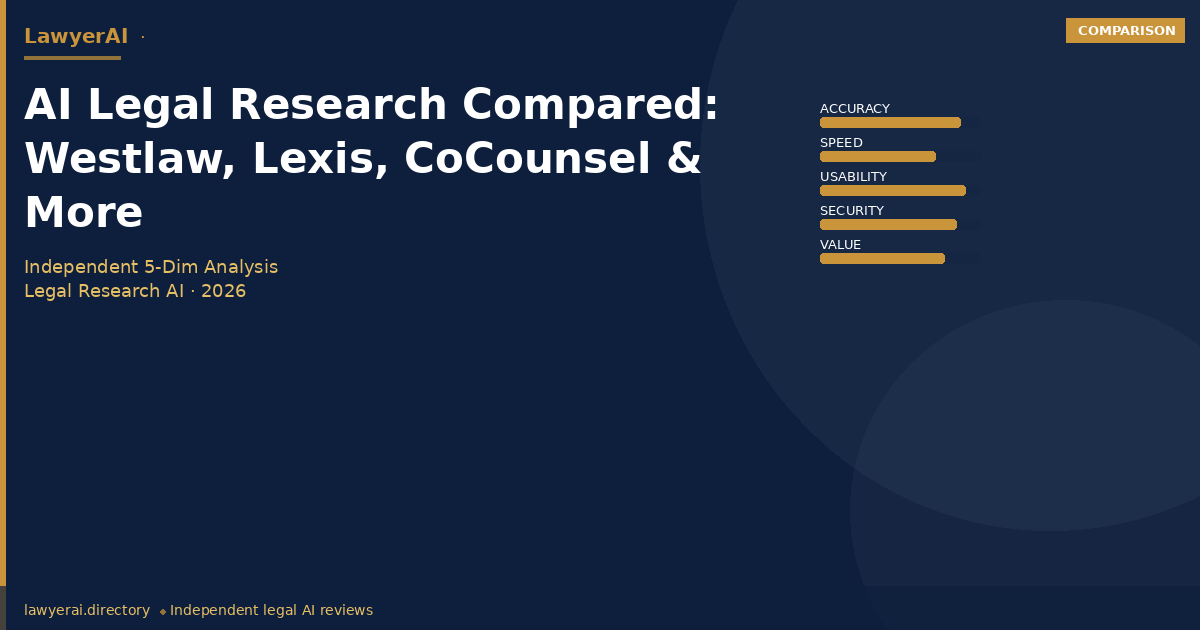
Short answer: The Stanford RegLab 2024 study measured Lexis+ AI and CoCounsel tied at 17% hallucination rate — the best accuracy in the benchmark. Westlaw Precision AI measured 33% in the same study. GPT-4 without legal grounding measured 88%. No independent hallucination data exists for Harvey AI, Paxton AI, or most other tools. If accuracy is your primary criterion and you have an existing Westlaw or LexisNexis subscription, Lexis+ AI or CoCounsel are the most defensible choices based on available evidence. If you need a lower-cost starting point without a legacy subscription, Paxton AI is accessible but unverified by independent benchmarks.
How We Score: The 5-Dimension Methodology
Every tool on LawyerAI is scored across five dimensions, each worth up to 5 points, for a maximum of 25 points. Full details at /methodology.
- Accuracy (1-5): Hallucination rate and citation accuracy from independent benchmarks. Stanford RegLab 2024 is the primary source for this category.
- Speed (1-5): Time from query to usable research output.
- Usability (1-5): Ease of integrating into existing research workflows without additional training.
- Value (1-5): Total cost including base subscription, per the subscription model structure.
- Security (1-5): Data handling, zero-retention options, and enterprise security certifications. Relevant to our rag-retrieval-augmented-generation entry — grounded retrieval tools have different security architectures than general LLMs.
At a Glance
| Tool Name | Category | Starting Price | Best For | 5D Score |
|---|
| Westlaw Precision AI | AI legal research | Westlaw base + add-on | Westlaw-primary firms | 17/25 |
| Lexis+ AI | AI legal research | Lexis base + add-on | LexisNexis-primary firms | 20/25 |
| CoCounsel | AI research + drafting | Westlaw base required | Westlaw subscribers | 20/25 |
| Casetext | AI legal research | Now CoCounsel only | Legacy Casetext users | N/A |
| Paxton AI | AI legal research | $65/seat/month | Budget-constrained users | 16/25 |
| Harvey AI | Multi-practice AI | $140K+/year | BigLaw, synthesis tasks | 21/25 |
1. Westlaw Precision AI
Westlaw Precision AI is Thomson Reuters's AI layer on the Westlaw database. The Stanford RegLab 2024 study — an independent academic benchmark, not a vendor-commissioned study — measured Westlaw Precision AI at a 33% error rate on legal research tasks. To put that in context: one in three AI-generated research outputs contained a material error before the researcher caught it. That does not make the tool unusable, but it establishes a mandatory verification baseline for any output destined for a court filing.
What works: Westlaw Precision AI sits inside the Westlaw interface, which means there is no new login, no additional platform, and no workflow disruption for attorneys already using Westlaw. The natural language query feature is faster than Boolean for broad, exploratory research questions. The AI surfaces relevant secondary sources alongside case law, which is valuable for attorneys building out a research framework before drilling into primary sources. For Westlaw-primary firms, the tool is the path of least resistance to AI-assisted research.
Real limitations: The 33% error rate from the Stanford RegLab 2024 independent benchmark is the defining limitation. That rate is approximately twice the error rate of Lexis+ AI and CoCounsel in the same study. Pricing is not published by Thomson Reuters — vendor-reported estimates range from $300-600 per seat per month, but actual pricing varies significantly by firm size and subscription package. The tool requires a Westlaw base subscription. For firms considering switching from LexisNexis to Westlaw primarily to access better AI research tools, the Stanford data does not support that decision.
2. Lexis+ AI
Lexis+ AI is the AI research assistant from LexisNexis, a division of RELX Group — a separate company from Thomson Reuters, which owns Westlaw. This distinction matters for procurement: Lexis+ AI and Westlaw Precision AI are direct competitors from different corporations, not products from the same vendor.
The Stanford RegLab 2024 study measured Lexis+ AI at a 17% hallucination rate — the same as CoCounsel and significantly better than Westlaw Precision AI's 33%. For the strongest independent accuracy evidence available, Lexis+ AI and CoCounsel share the top position.
What works: The 17% hallucination rate, while still requiring verification of outputs, represents materially better accuracy than the alternatives in the Stanford benchmark. For LexisNexis subscribers, Lexis+ AI integrates into the existing platform. The Shepardizing integration means the AI's citation suggestions are automatically checked for current validity, which addresses one category of hallucination — citing cases that have been overruled. Regulatory research and administrative law coverage are strong, which matters for practices with significant agency-related work.
Real limitations: Lexis+ AI requires an existing LexisNexis subscription. Individual and firm pricing is not published (vendor-reported estimates: $150-400 per seat per month depending on content packages). The 17% hallucination rate still means manual verification is non-optional before any AI-generated citation appears in a filing. The tool is primarily a research tool — for contract review or document drafting, separate tools are needed. For solo practitioners and small firms, the cost of a full LexisNexis subscription plus the AI add-on may exceed budget constraints.
3. CoCounsel
CoCounsel is Thomson Reuters's AI research and drafting assistant, built on the technology acquired from Casetext in June 2023 ($650 million acquisition). CoCounsel operates on the Westlaw corpus and has the same 17% hallucination rate as Lexis+ AI in the Stanford RegLab 2024 benchmark. For Westlaw subscribers, CoCounsel is the highest-accuracy AI research option from the same vendor.
What works: CoCounsel's citation integrity is anchored by the Westlaw corpus — citations are pulled from a curated, continually updated legal database rather than the open internet. The document review feature can process uploaded contracts and other documents and flag issues or relevant precedents against configurable parameters. Memo drafts include inline citations that link back to underlying Westlaw source documents, which speeds up the verification step. The research task capability — producing a structured research memo on a defined legal question — is faster and more organized than starting from scratch in Westlaw's search interface.
Real limitations: CoCounsel cannot be purchased without an existing Westlaw subscription. Westlaw base plans start at approximately $3,600 per year for individual attorneys, and firm pricing is significantly higher. If your firm is a LexisNexis shop, you are not cross-shopping CoCounsel — you are looking at Lexis+ AI. CoCounsel's contract review capabilities are limited compared to dedicated tools like Spellbook or Luminance. It is a research-and-drafting tool, not a CLM or contract review specialist. See our comparison of CoCounsel vs Westlaw Precision AI for the detailed head-to-head on the Thomson Reuters platform's own products.
4. Casetext
Casetext was acquired by Thomson Reuters in June 2023 for $650 million. Following the acquisition, Casetext's core AI legal research capabilities were rebranded as CoCounsel and integrated into the Westlaw ecosystem. The standalone Casetext purchase path — which previously allowed independent access to AI legal research without a Westlaw subscription — has been closed for new customers.
What works: For attorneys and firms that had established Casetext workflows before the acquisition, the underlying technology that made Casetext valuable — its retrieval-augmented generation approach to case law research — is now the foundation of CoCounsel. The transition preserved the core functionality while adding Westlaw's broader corpus access.
Real limitations: Casetext as an independent product is no longer available to new buyers. If you are evaluating AI legal research tools today and someone recommends "Casetext," they are referring to CoCounsel — and that requires a Westlaw subscription. The pre-acquisition independent pricing (approximately $65-100 per seat per month standalone) is not available. Attorneys who relied on Casetext as a budget-accessible alternative to Westlaw and LexisNexis have lost that access path.
5. Paxton AI
Paxton AI is the most accessible AI legal research tool in the current market at $65 per seat per month with no minimum seat requirement. It is designed for attorneys who need AI-assisted legal research without committing to a full Westlaw or LexisNexis subscription, and for small firms and solos for whom the major platform pricing is prohibitive.
What works: Paxton AI's price point is its primary differentiator. At $65 per seat per month, a solo attorney can access AI-assisted legal research for less than the cost of a single Westlaw module. The tool covers federal and state case law, statutes, and regulations, with a conversational research interface that produces summaries and citation suggestions. For state law research and standard legal questions in common practice areas, Paxton AI is a practical option.
Real limitations: No independent hallucination rate has been published for Paxton AI. The Stanford RegLab 2024 benchmark did not include Paxton in its study set. The corpus is smaller than Westlaw and LexisNexis, which affects coverage of older cases, specialty law areas, and secondary sources. For federal appellate brief research or complex multi-jurisdictional analysis, the corpus limitations are a genuine constraint. For any output destined for a court filing, the absence of independent accuracy data means verification protocols must be especially rigorous. See our citation-validation entry for the specific verification steps to apply.
6. Harvey AI
Harvey AI is not primarily a legal research tool — it is a multi-practice AI platform for large law firms. Its research capability is real but secondary to its value proposition. Where Harvey AI differentiates in the research context is on synthesis tasks: multi-issue legal analysis, cross-jurisdictional surveys, and regulatory landscape summaries that require assembling information across many sources and producing an integrated output.
What works: For senior attorneys who need a structured legal memorandum on a complex question — not a list of cases, but an organized analysis of the law and its application — Harvey AI's synthesis capability is strong. The output reads like an attorney's memo rather than a database search result, which reduces the editing required to produce a client-ready product. For BigLaw practices with Harvey deployed, the tool's breadth across practice areas means a single platform handles research across M&A, finance, employment, and regulatory matters.
Real limitations: Harvey AI starts at $140,000 per year with a 50-seat minimum. No independent hallucination rate has been published. The Stanford RegLab 2024 benchmark, which is the primary independent accuracy source for legal AI research tools, did not include Harvey. For attorneys evaluating research tools on accuracy grounds alone, Lexis+ AI and CoCounsel have the only verified independent data. Harvey's value on research tasks is calibrated to complex synthesis, not routine case law lookups that a Westlaw or Lexis search handles efficiently.
Decision Tree
Find your closest match:
- If you are an existing Westlaw subscriber wanting AI assistance on top of your current platform → add Westlaw Precision AI or CoCounsel (CoCounsel has better accuracy per Stanford RegLab)
- If you are an existing LexisNexis subscriber → add Lexis+ AI (17% hallucination rate, best in independent benchmark)
- If you have no traditional database subscription and need a budget-accessible starting point → Paxton AI ($65/seat/month, no independent accuracy data yet)
- If your practice involves international law → consider vLex (not on LawyerAI item list currently), which has broader non-US jurisdiction coverage than the major US platforms
- If you need complex multi-issue synthesis rather than case law search → Harvey AI (if your firm has the budget and seat count)
Frequently Asked Questions
What happened to Casetext?
Casetext was acquired by Thomson Reuters in June 2023 for $650 million. The standalone Casetext product has been rebranded as CoCounsel and integrated into the Westlaw platform. New buyers cannot purchase the pre-acquisition standalone Casetext product. Existing Casetext users were transitioned to CoCounsel, which requires a Westlaw subscription. Attorneys who valued Casetext as a budget-accessible AI research tool without a Westlaw subscription no longer have that access path through the CoCounsel brand.
Which AI legal research tool has the lowest hallucination rate?
Based on the Stanford RegLab 2024 independent benchmark, Lexis+ AI and CoCounsel are tied at 17% hallucination rate. Westlaw Precision AI measured 33% in the same study. GPT-4 without legal grounding measured 88%. No independent hallucination rate has been published for Harvey AI, Paxton AI, or most other tools. When evaluating any tool whose vendor cites an accuracy number, ask whether the benchmark is independent (Stanford RegLab, academic institutions) or vendor-commissioned. Vendor-commissioned accuracy studies are not counted in our ratings. See our ai-hallucination entry for what hallucination rates mean in practice.
Do I need both Westlaw and LexisNexis subscriptions?
Most firms maintain one primary research platform, not both. The historical argument for dual subscriptions — that each platform had exclusive content the other lacked — has weakened as both platforms have expanded their coverage. For firms making a primary platform decision today, the Stanford RegLab 2024 benchmark provides a data point: Lexis+ AI at 17% versus Westlaw Precision AI at 33% on research accuracy. That is a meaningful difference if AI-assisted research accuracy is your primary criterion. The decision ultimately turns on pricing, existing integrations, and workflow preference.
How do I verify an AI-generated legal citation?
The minimum verification process for any AI-generated citation before use in a filing: confirm the case exists in the official reporter; confirm the citation format is correct; confirm the holding is accurately stated; confirm the case is still good law (Shepardize or KeyCite); confirm the jurisdiction is correct for your argument; confirm the case actually supports the proposition you are citing it for; and confirm you have read the case, not just the AI's summary of it. Seven steps, no shortcuts. See our citation-validation glossary entry for the full protocol.
Are these tools accurate enough for federal court filings?
The short answer is: not without manual verification of every citation. The 17% hallucination rate for Lexis+ AI and CoCounsel means that in a memo with 20 citations, statistically 3 or 4 will have a material error before the attorney catches it. That error rate requires a systematic verification protocol, not spot-checking. The Mata v. Avianca sanctions (2023) established that courts will sanction attorneys for AI-generated citations that were not verified. The tool accuracy question is secondary to the verification protocol question — any tool's output, including the most accurate ones, must be verified before it goes in a filing.
Editorial Independence
LawyerAI evaluations are independent. We do not accept payment that influences our editorial scores. Featured placements are clearly labeled and do not affect our 5-dimension methodology (Accuracy / Speed / Usability / Value / Security). We re-review tools every 6 months.
If you believe any information is inaccurate, contact editor@lawyerai.directory.